
Home / Blog
Take your digital marketing to the next level with data-driven strategies and innovative solutions. Let’s create something amazing together!
Volatility, uncertainty, and rapid market shifts have become defining characteristics of modern commodity markets and global supply chains. Traditional decision-making approaches, based largely on historical reporting and intuition, are no longer sufficient. This is where predictive and prescriptive analytics are transforming how organizations operate, compete, and grow.
Predictive analytics leverages data mining, statistical modeling, and machine-learning algorithms to forecast future outcomes. In commodity-driven industries, this includes predicting price movements, yield variations, demand fluctuations, and market volatility. By analyzing time-series data across multiple variables, organizations gain forward-looking insights that allow them to anticipate market changes rather than react to them.
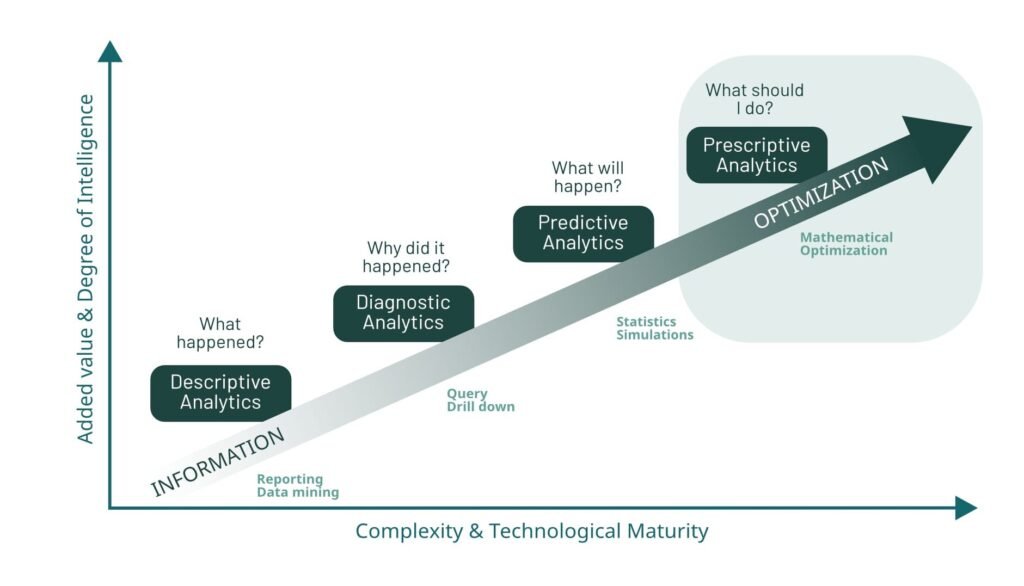
However, knowing what is likely to happen is only part of the equation. Prescriptive analytics takes predictive insights a step further by recommending optimal actions. It integrates predictive models with business rules, optimization techniques, and simulation to answer a more critical question: what should we do next? For example, prescriptive analytics can recommend pricing strategies that maximize margins, inventory levels that minimize holding costs, or logistics routes that reduce operational risk.
In commodity markets such as chemicals, biomass, and food, these capabilities are especially valuable. Price volatility can significantly impact profitability, while supply-chain disruptions can lead to missed opportunities or financial losses. Predictive analytics helps organizations forecast commodity price momentum and demand trends, while prescriptive analytics identifies the best responses under varying scenarios.
The result is a more resilient, data-driven operation. Companies can proactively manage risk, improve planning accuracy, and align their supply-chain strategies with real-time market conditions. Decisions are no longer based solely on past performance but are informed by a continuous understanding of future possibilities.
As markets grow more complex, the organizations that succeed will be those that combine predictive foresight with prescriptive action. By adopting advanced analytics, businesses can turn uncertainty into opportunity and drive measurable, long-term value.

Digitap is a cutting-edge machine-learning analytics firm focused on driving innovation in agriculture, commodity trading, food, manufacturing, and supply chain verticals.