
Home / Blog Post
Take your digital marketing to the next level with data-driven strategies and innovative solutions. Let’s create something amazing together!
Business intelligence (BI) has long been a cornerstone of enterprise analytics. By collecting and integrating historical and current data, BI provides a descriptive view of what has happened and what is happening now. Dashboards, reports, and KPIs enable organizations to monitor performance and identify trends. However, in today’s fast-moving markets, descriptive insight alone is no longer enough.
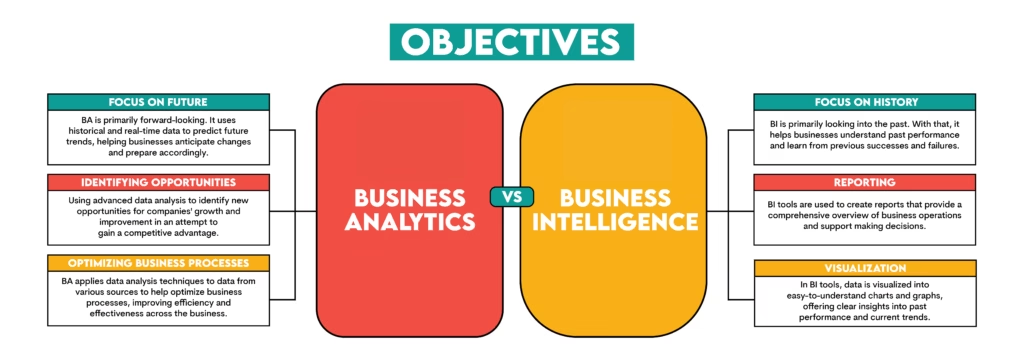
This is where predictive and prescriptive analytics extend the value of traditional BI. While BI answers the question “what happened?”, predictive analytics focuses on “what will happen?” Using data mining and machine-learning techniques, predictive models forecast future outcomes such as price movements, demand levels, risk exposure, and probability scenarios.
Prescriptive analytics then builds on these forecasts to answer the most strategic question: “what should we do?” By combining predictive outputs with optimization models, simulation, and business constraints, prescriptive analytics defines specific actions that lead to the best possible outcomes.
The key difference lies in decision-making impact. BI supports awareness and monitoring, but predictive and prescriptive analytics actively guide decisions. For example, a BI dashboard may show declining margins, while predictive analytics forecasts continued pressure due to market trends. Prescriptive analytics goes further by recommending pricing adjustments, supply-chain changes, or inventory strategies to protect profitability.
Modern enterprises increasingly require this full analytics continuum. BI remains essential for transparency and performance tracking, but predictive and prescriptive analytics enable organizations to be forward-looking and action-oriented. Together, they create a comprehensive analytics ecosystem that supports strategic planning and operational execution.
As competition intensifies and data volumes grow, organizations that rely solely on BI risk falling behind. Those that integrate predictive and prescriptive analytics gain a decisive advantage by turning insight into impact. In a data-driven economy, the ability to anticipate and act is what truly differentiates market leaders.
The key difference lies in decision-making impact. BI supports awareness and monitoring, but predictive and prescriptive analytics actively guide decisions. For example, a BI dashboard may show declining margins, while predictive analytics forecasts continued pressure due to market trends. Prescriptive analytics goes further by recommending pricing adjustments, supply-chain changes, or inventory strategies to protect profitability.
Modern enterprises increasingly require this full analytics continuum. BI remains essential for transparency and performance tracking, but predictive and prescriptive analytics enable organizations to be forward-looking and action-oriented. Together, they create a comprehensive analytics ecosystem that supports strategic planning and operational execution.
As competition intensifies and data volumes grow, organizations that rely solely on BI risk falling behind. Those that integrate predictive and prescriptive analytics gain a decisive advantage by turning insight into impact. In a data-driven economy, the ability to anticipate and act is what truly differentiates market leaders.

Digitap is a cutting-edge machine-learning analytics firm focused on driving innovation in agriculture, commodity trading, food, manufacturing, and supply chain verticals.